This article looks at the role of an infantry divisional signals in the Second World War. The page will explain what an infantry divisional signals was, how the unit was structured and how to research both the units and those who served with them. This is one of a series of articles I’ve written to help you in your research:
I also offer a Second World War Soldier Research and Document Copying Service.
Infantry Divisional Signals in the Second World War
Infantry divisional signals were units of the Royal Corps of Signals and each infantry division contained one. There were also armoured and airborne divisional signals for the armoured and airborne divisions. Each armoured division had an armoured divisional signals. The units took their designations from the number of the division they served in. For example, the 9th (Highland) Division contained the 9th (Highland) Divisional Signals and the 51st (Highland) Division the 51st (Highland) Divisional Signals. During the First World War, the equivalent unit had been a divisional signals company of the Royal Engineers. The role of a divisional signals was recorded in Signal Communications by Colonel T. B. Gravely, a War Office publication which is an important source of information on the Royal Corps of Signals:
The main task of a divisional signals has always been to provide the commander and his staff with the communications they need in order to fight and to maintain the division, and to supervise and integrate the communications operated by other arms.
The key communication links were between the divisional commander, his three infantry brigades and the formation’s artillery. A divisional signals also set up communication with nearby formations and links to the corps commander. Soldiers serving with a divisional signals unit were often dispersed over a wide area to enable them to maintain communication links. Communication was achieved through the use of wireless, the laying of telephone lines and motorcycle despatch riders. Initially, a divisional signals consisted of a headquarters and three companies but later in the war, its composition was changed to a headquarters and four squadrons. The photograph below shows Despatch Riders of the London Divisional Signals, a Territorial Army unit, training near London in 1936.

Each unit of the British Army had its own war establishment which recorded its structure and composition. An infantry divisional signals went through a number of changes during the war and only the first, “Notified in Army Council Instructions for the week ending 27th July, 1938” is outlined below. This war establishment was designated II/1931/11/4 and had replaced the short-lived II/1931/11/3 which had been “Notified in Army Council Instructions for the week ending 7th April,1937”. Both establishments can be found in WO 24/935: War Establishments 1937-1938 held at the National Archives in London. The 1938 establishment was replaced by II/1931/11/5 notified on 14 August 1940 but the two were very similar. More establishments followed, with the most dramatic changes being the size of an infantry divisional signals which rose from 491 all ranks in 1938 to 743 in 1945. In 1946, the strength of a divisional signals reached 892. The structure also changed from a headquarters and three companies to a headquarters and four sections.
1938 Infantry Divisional Signals War Establishment
An infantry divisional signals was commanded by a Lieutenant-Colonel who was one of eighteen officers serving with the unit. A Major was second-in-command. Then there were 473 other ranks, including a Shoemaker attached from the Royal Army Ordnance Corps. This gave a divisional signals a total strength of 491 all ranks. The unit was structured as follows:
Headquarters
No.1 company, containing wireless, cable, operating and technical maintenance sections and providing communication between divisional headquarters and infantry brigades and divisional cavalry regiment; and between headquarters divisional artillery and artillery regiments
No.2 company, containing signal sections for artillery regiments
No.3 company, containing signal sections for infantry brigades
The headquarters was the smallest part of the unit containing four officers and twenty-five other ranks. No.1 company was the largest and was split into a headquarters, A (wireless) section, B (cable) section, C (divisional cavalry) section, D (operating) section and M (technical maintenance) section. The company was commanded by a Major, one of six officers serving with it and there were 228 other ranks, giving it a total strength of 234 all ranks. No.2 Company contained a headquarters, E, F and G (field regiment Royal Artillery) sections and H (anti-tank regiment) section. This company was commanded by a Captain, one of four officers serving with it and there were 109 other ranks giving a total strength of 113. No.3 Company was divided into a headquarters, and J, K and L (infantry brigade) sections. The company was also commanded by a Captain, one of four officers serving with it and there were 111 other ranks, giving it a total strength of 115.
Of the other ranks serving with a divisional signals, 343 were tradesmen, having passed a trade test in a specific skill. This information should be recorded in a soldier’s service record. These tradesmen included forty-six Despatch Riders, sixty-two Linemen and 168 Operators (signals). The ninety-seven non-tradesmen were Drivers I.C. (Internal Combustion) who looked after and maintained the unit’s vehicles, were Batmen or on sanitary or water duties. For transport, the unit had a wide variety of vehicles which included seventy-nine motorcycles, forty-five 8-cwt 4-wheeled wireless trucks and fourteen 15-cwt 4-wheeled cable laying and line maintenance trucks. For armament, a unit had 151 .38-inch Webley revolvers, 339 Lee-Enfield rifles and 12 Anti-tank rifles, .55-inch (Boys Anti-Tank Rifles).
Researching an Infantry Divisional Signals
The most important document to research an infantry divisional signals is its war diary, written by one of its officers. A war diary recorded a unit’s location and day-to-day activities and often contain appendices in the form of maps, orders, reports, etc. I offer a copying service for these documents which are held at the National Archives in London. The National Archives’ hasn’t catalogued the units as divisional signals, so you’ll have to search the number of the division followed by “division” and “Signals” to find the correct war diaries. For example, if you wanted to find the 1st Infantry Division’s Divisional Signals you’d search “1 division signals” but without the quotation marks. Chapter 26 of Signal Communications by Colonel T. B. Gravely provides a very good history of infantry divisional signals during the war, looking at how they operated, organization, training etc. If the division of the divisional signals you’re researching published a history after the war, it would be well worth looking at a copy for additional context and the maps. Just don’t expect many mentions of the divisional signals, if at all.
Researching a Soldier who Served in an Infantry Divisional Signals
The most important document to research a soldier who served in an infantry divisional signals is their service record. Each unit a soldier served with will be recorded in their file along with the dates they served with it. This will allow you to find the correct war diaries at the National Archives to find out where a soldier served and their unit’s activities. A service record will either be held by the Ministry of Defence or National Archives. Ordering a copy is usually straightforward and I’ve written a guide to help you. If you’re researching a soldier who served in the ranks and they passed a trade test or were a Driver I.C., this information will usually be recorded in their service record. This will allow you to research the specific role of a soldier within a divisional signals.
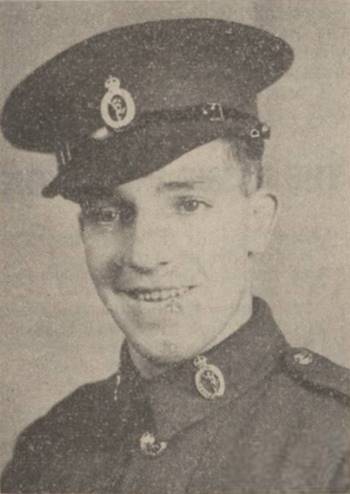
There are a small number of digitized records which may be of use, especially if you’re researching a casualty. The casualty lists for the British Army between 1939 and 1945 have been digitized and are available to view on Findmypast. Findmypast also has a collection of prisoner of war records, and the British Newspaper Archive. The latter collection is important if you’re researching a casualty but only a small fraction of the newspapers from the Second World War have been digitized. Though, more are being continually added. The photograph below shows Signalman Kenneth Stewart who was killed in action on 29 May 1940, his birthday, while serving with the 3rd Divisional Signals. The photograph was published in The Stirling Observer on 25 June 1940 which devoted three short paragraphs to his death. While brief, they contain key information regarding his pre-war life and the circumstances of Kenneth’s death. Kenneth was killed when the ship he was on was bombed while leaving Dunkirk and he is commemorated on the Dunkirk Memorial.
If a soldier was awarded a gallantry medal or honour, you can search for their citation using the National Archives’ catalogue. They are part of the WO 373 series and can be downloaded for a small fee. If a soldier died between 3 September 1939 and 31 December 1947, you can search the Commonwealth War Graves Commission’s database for a record of their death. This will provide you with a variety of information, including their number, often their unit, date of death if known and where they are buried or commemorated.