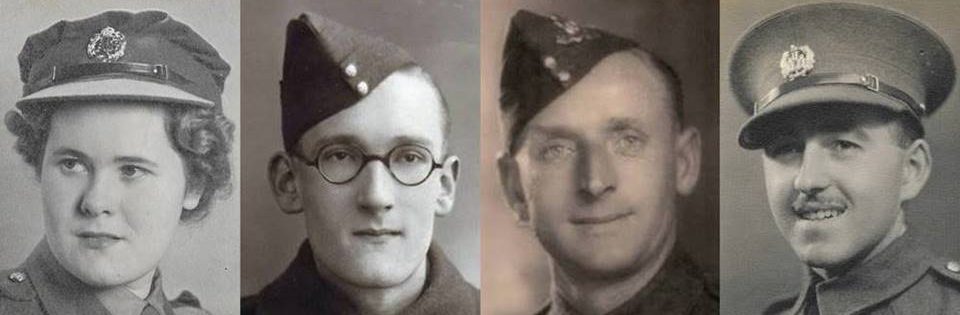
This article looks at a file held at the National Archives in London relating to three soldiers of the British Army who were reported missing when the Motor Vessel Queen Victoria was sunk on 28 June 1942. The file’s catalogue reference is WO 361/186: Casualties at Sea: SS Queen Victoria, missing since 28 June 1942, after leaving Birkenhead. This page is one of a series of articles looking at WO 361 files. In addition, I have also written a guide to using the WO 361 series to research both soldiers and units. It is one of a series of articles to help you research soldiers who served in the British Army during the Second World War:
- Researching Soldiers using the WO 361 series
- Guides to Researching Soldiers who served in the British Army
I also offer a Second World War Soldier Research and Document Copying Service.
The Loss of the Motor Vessel Queen Victoria
The Motor Vessel Queen Victoria was a Queen Line Ltd. (Thomas Dunlop & Sons) motor cargo ship which was launched in 1936. The ship had a gross register tonnage of 4937 and a length of 418.2 feet (127.4 m). Between 1939 and early 1942, the Queen Victoria travelled extensively across the globe, including visiting Alexandria, Gibraltar, Panama, Sydney, and Vancouver. Its exact movements prior to its final voyage during the war can be tracked by downloading its Merchant Shipping Movement Card. This document is held at the National Archives and can be downloaded for free if you register. On 11 May 1942, the ship left Birkenhead to carry military stores to Aden, in what is now Yemen. Aden was an important stop for ships travelling between Egypt and India and had a garrison of British, Indian and locally raised soldiers. The Queen Victoria left the Mersey on 12 May and arrived at Table Bay, South Africa on 14 June. Here, the ship remained until 21 June when it sailed for Aden.
On 28 June, the Queen Victoria was torpedoed and sunk with the loss of all crew and passengers by the Japanese submarine I-10. The ship’s Merchant Shipping Movement Card recorded its estimated position as “21° 15′ S, 40° 30′ E” in the Mozambique Channel. This was between Mozambique and Madagascar. In May, Madagascar had been invaded by an Allied force, and Japan had sent a small number of submarines to the area, one of which was the I-10. The I-10 was later sunk with all hands by the U.S.S. David W. Taylor and Riddle on 4 July 1944. The Tower Hill Memorial records the names of thirty-one members of the crew who lost their lives in the attack. Two of the crew, Cabin Boy George McVeigh and Cadet Charles Paterson Macintyre were only sixteen, while Ordinary Seaman William Craig was seventeen. There were also three British soldiers travelling on board the Queen Victoria and WO 361/186 contains a small amount of correspondence regarding enquiries into the ship’s fate. None of the documents contained within the file shed any light on the circumstances in which the ship was lost. However, they do name the three unfortunate soldiers who were on board. All three are commemorated on the Brookwood 1939-1945 Memorial. The three soldiers who died were:
6346488 Sergeant John Albert Thomas Curtis 4th Battalion The Queen’s Own Royal West Kent Regiment. Aged twenty-seven, John was the son of Thomas and Elsie Curtis, and husband of Joan Mary Curtis of Retford, Nottinghamshire. John is also commemorated on the Leigh War Memorial.
6288357 Serjeant Michael Anthony Ferrero 2nd Battalion The Buffs (Royal East Kent Regiment). Aged twenty-two he was the son of Marius A. Ferrero and Domenica Ferrero, of Folkestone, Kent.
6282603 Serjeant Henry Samuel Cruse 2nd Battalion The Buffs (Royal East Kent Regiment). Aged thirty-five, Henry was the son of Henry Samuel and Lizzie Cruse, and the husband of Kathleen Cruse, of Cotton End, Bedfordshire.