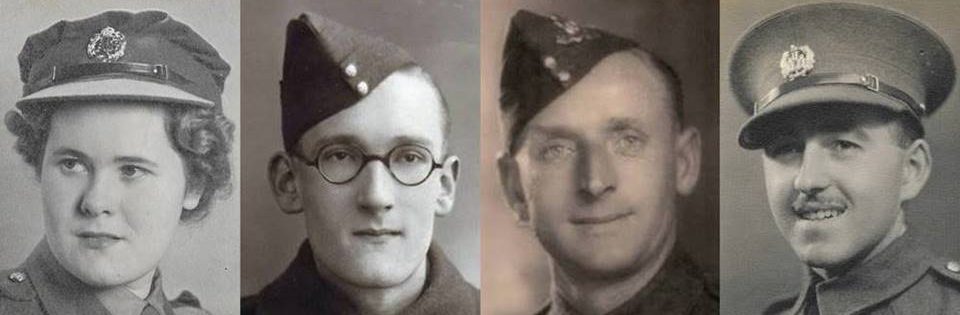
This article looks at a file held at the National Archives in London relating to the soldiers of the British Army who died when the M.V. Abosso was sunk on 29 October 1942. The file’s catalogue reference is WO 361/406: Casualties at sea, Atlantic: HMT Abosso, sunk en route from Cape Town to UK, 29 October 1942. This page is one of a series of articles looking at WO 361 files. In addition, I have also written a guide to using the WO 361 series to research both soldiers and units. It is one of a series of articles to help you research soldiers who served in the British Army during the Second World War:
- Researching Soldiers using the WO 361 series
- Guides to Researching Soldiers who served in the British Army
I also offer a Second World War Soldier Research and Document Copying Service.
The Loss of the M.V. Abosso
The Motor Vessel Abosso was an Elder Dempster Lines passenger and cargo ship which was launched in 1935. The ship had a gross register tonnage of 11,330 and a length of 460.8 feet (140.45 m). Between 1939 and its sinking, the Abosso had spent its time sailing between Africa and Britain. During this period, the ship visited a variety of ports, mostly on the west coast of Africa and Britain, including Freetown, Lagos, and Takoradi. Its exact movements during the war can be tracked by downloading its Merchant Shipping Movement Card. This document is held at the National Archives and can be downloaded for free if you register. On 20 June 1942, the Abosso left Liverpool as part of convoy WS 20 and arrived at Freetown, Sierra Leone on 2 July. Four days later, the Abosso sailed for Cape Town which was reached on the 18th. From Cape Town, the Abosso sailed to Bombay, now Mumbai, Diego Suarez (Antsiranana), Tanga, and Mombasa, before reaching Durban on 26 September. From Durban, the Abosso sailed to Cape Town which it reached on 30 September. On 9 October, the Abosso left Cape Town heading for Britain.
There were 393 people on board the Abosso when the ship left South Africa. Eighteen of them were soldiers from the British Army. On 29 October, the Abosso, which was sailing alone, was hit by a torpedo from the German submarine U-575. The ship’s position at the time it was hit was recorded in its Merchant Shipping Index Card as 48° 30 N 28° 50’ W, nearly 600 miles north of the Azores. Another torpedo struck the Abosso about fifteen minutes after the first, and the ship remained afloat for around fifty minutes after the first hit. Despite multiple lifeboats being launched, heavy seas meant that only a single one containing thirty-one people was sighted. H.M.S. Bideford which was part of convoy KMS-2 spotted this lifeboat on 31 October. The rest of those on board either died during the sinking or shortly afterwards. Of the eighteen British soldiers on board, only Captain John J. Reeks of the Royal Army Medical Corps survived.
File WO 361/406 contains correspondence relating to the British soldiers who were on board the Abosso when it sank. There is also correspondence relating to two of the civilians on board, eighteen-year-old Ann de la Bere and Mrs Anne Thorne. This includes a copy of a letter sent to the mother of Ann. Her father was Brigadier-General van de la Bere. The most important documents in the file are two eyewitness accounts by Captain John Reeks about the ship’s sinking. The first was dated 11 December 1942 and was sent to the Adjutant General Army Medical Services and the second was dated 12 December 1942 and sent to the Under Secretary of State for War. The first account is transcribed below as it’s a lot more detailed. The following soldiers were on board the Abosso when the ship was sunk and are listed in alphabetical order by surname. All are commemorated on the Brookwood 1939-1945 Memorial.
- S/5828726 Staff Sergeant Patrick Daniel Booth Royal Army Service Corps
- 5106508 Squadron Quartermaster Sergeant Sydney Norman Bough Royal Armoured Corps
- 4030 Lieutenant-Colonel Lance Ernest Cecil Dale-Lace Royal Artillery
- 3761768 Quartermaster Serjeant Percy Edwards Royal Army Medical Corps
- 279088 Private Alexander Farrell Royal Army Medical Corps
- 7401381 Private John Leslie Harrison Royal Army Medical Corps
- 1548224 Warrant Officer Class II Frank Fricker Hawkins Royal Army Medical Corps
- 7346788 Private James Hopper Leslie Royal Army Medical Corps
- 7349490 Private John Edward Parker Royal Army Medical Corps
- 7812137 Serjeant Frederick Victor Peters Royal Armoured Corps
- 154085 Captain John J. Reeks – Survived
- 7380593 Private Norman Roughley Royal Army Medical Corps
- 7261465 Serjeant Hayden Arthur David Stanley Royal Army Medical Corps
- 5628885 Lance-Corporal Vyvyan Marshall Strick Devonshire Regiment
- 7377354 Private James Turnbull Royal Army Medical Corps
- 13088192 Private William George Walker Royal Army Medical Corps
- 7520146 Serjeant Willie Wainwright Royal Army Medical Corps
- 825174 Private Harold Owen Way Royal Army Medical Corps
The following is a transcription of an account of the sinking and aftermath written by Captain John J. Meeks on 11 December 1942.
Copy
Secret.
To: Adjutant General Army Medical Services.
From: Captain J. J. Reeks, R.A.M.C.
Subject: Report on Sinking of His Majesty’s Transport Abosso
Sir,
I have the honour to submit this report as you requested.
His Majesty’s Transport Abosso sailed from Capetown, South Africa, on 8th October, 1942, and carried the following:-
British Army. Lieutenant-Colonel L. E. C. Dale-Lace, M.C. Royal Artillery, Officer Commanding Troops, Captain J. J. Reeks, Royal Army Medical Corps, Senior Medical Officer. Three Warrant Officers. Four non-commissioned officers. Nine Privates (ships permanent staff).
Royal Navy. Three naval ratings.
Royal Air Force. About 20 officers and 10 other personnel.
Royal Netherlands Navy. Four officers and 28 other ranks.
Royal Netherlands Army. Two officers and 47 other ranks.
Civilians. Ten women and about seven men, including a Frenchman returning to join the Fighting French.
Merchant Navy. Total of 186 officers and men composing the Abosso’s crew.
Internees. About 43 Germans, Italians, Austrians and Czechs returning for release.
The above numbers are only approximate in some cases.
. . . .
At 18:15 hours on 29th October, 1942, the Abosso’s position was roughly 50’ N. and 30’ W, and she was steaming in a north-easterly direction to Liverpool, when a torpedo struck her on the port side, and as far as I can gather, forward of amidships.
The lights immediately went out and she took a 30’ list to port. Within a few minutes the emergency torches gave sufficient light for the passengers to find their way to the boat stations. My boat was on the starboard side and the list was to port, combined with the fact that the starboard was also the windward side, made the lowering of these boats the most difficult.
The list was sufficiently marked to cause the starboard boats to become jammed against the Abosso’s side. On our boat reaching the water we managed, after some difficulty, to push it away from the sinking ship, and when some forty yards away I noticed that three of the other starboard boats were also in the water and clear of the ship’s side. One of these other boats was the motor life-boat which was cruising round and looking, I should imagine, for people in the water.
The boat next to ours however, tipped up suddenly whilst being lowered, and threw everybody into the sea before crashing down herself. We managed to pick up three of these persons, but unfortunately did not see the rest. I fear the boat must have crashed on to them. Although it was a dark night it was possible to see all this in the dim but adequate emergency lights that had been switched on on the boat deck.
We eventually pulled away for a distance of some 250 yards to await events, and whilst in this position a second torpedo went past our boat at a distance of about 15 yards, and struck the Abosso amidships on the starboard side. This second torpedo struck some 20-25 minutes after the first, and the ship went down at the bow and slid under the water about 10-15 minutes later. In my opinion, the total time taken for the Abosso to sink was between 30 and 40 minutes and possibly a little longer.
. . . .
I have the following but very limited information to give about certain of the passengers:
I was in Lieutenant-Colonel Dale-Lace’s cabin having a drink before dinner when the ship was struck. The Colonel left his cabin with me and proceeded to his boat station whilst I went down to the hospital. On the way down I passed the only two patients – both internees – and the Royal Army Medical Corps orderlies, but did not see Quartermaster Sergeant Edwards or Sergeants Wainwright or Stanley. The three naval ratings who were in our boat have stated to me that all eight of the Royal Army Medical Corps orderlies were unhurt and were last seen by them on the boat station deck proceeding to their allotted places.
For the first night we remained around the post where the Abosso sank, in the hope of contacting some of the other boats at daylight. When dawn broke, however, we saw no sign of another boat or any floating wreckage. The seas were sufficiently rough to reduce visibility to a few yards. We sailed throughout the daylight of 30th October, during which day the seas became increasingly rough. During the night October 30-31, a gale blew and the seas were so rough we considered the boat would be lost at any moment. Dawn the next day brought slightly better weather, and at about 12:00 hours on October 31, we were sighted and picked up by one of His Majesty’s ships acting as an escort to a convoy.
I was given to understand that we had covered 35 miles since being wrecked. A warship was detached from the convoy for the rest of that day to look for other boats, but returned that night having no success. I understand that on November 1, a message was received from the Abosso’s motor life-boat giving her position.
I should like to take this opportunity to bring to your notice the conduct of Lieutenant-Commander H. C. J. Coumou, Royal Netherlands Navy, who with full approval of all, took command of our lifeboat. Throughout the whole of the boat’s journey he remained at the tiller, refusing to take sleep, as he realised there was nobody as fitted as himself to weather the rough seas. Day and night he never ceased to encourage and coach us in the handling of the boat. I unhesitatingly state that in my opinion, we survived because of his skill, perseverance and courage. His conduct the whole time was exemplary and an inspiration to all.
I have the honour to be, Sir,
Your obedient servant,
(Signed) John J. Reeks,
Captain, Royal Army Medical Corps
Senior Medical Officer, His Majesty’s Transport Abosso.
Mill Side,
Upton Park, Chester,
11th December, 1942.